
Strontium Optical Clocks
Clock Technologies Based on Thermal and Ultracold Strontium
Open Positions
Interested in joining the team? Please see our current open positions.
If you are interested in a Bachelor’s or Master’s thesis project, please get in touch. We are happy to discuss possible topics and see whether we can find a suitable project.
General Introduction
Strontium offers electronic energy levels that enables the development of a variety of optical frequency references with different levels of complexity.
Our work focuses on developing compact and robust clock systems for future applications in space and industry, including next-generation GNSS, data synchronisation and long-distance frequency distribution.
Advancing these systems towards space operation also opens new possibilities for fundamental science, including searches for dark matter, gravitational-wave detection, and tests of local position invariance.
Ramsey-Bordé Clocks
Ramsey-Bordé interferometry combines the advantages of Doppler-free spectroscopy and Ramsey interrogation, enabling narrow spectroscopic features even with a thermal atomic ensemble.
This makes it an attractive approach for compact optical clocks with potential fractional frequency instabilities below 10−15, implemented within only a few height units of a 19-inch rack.
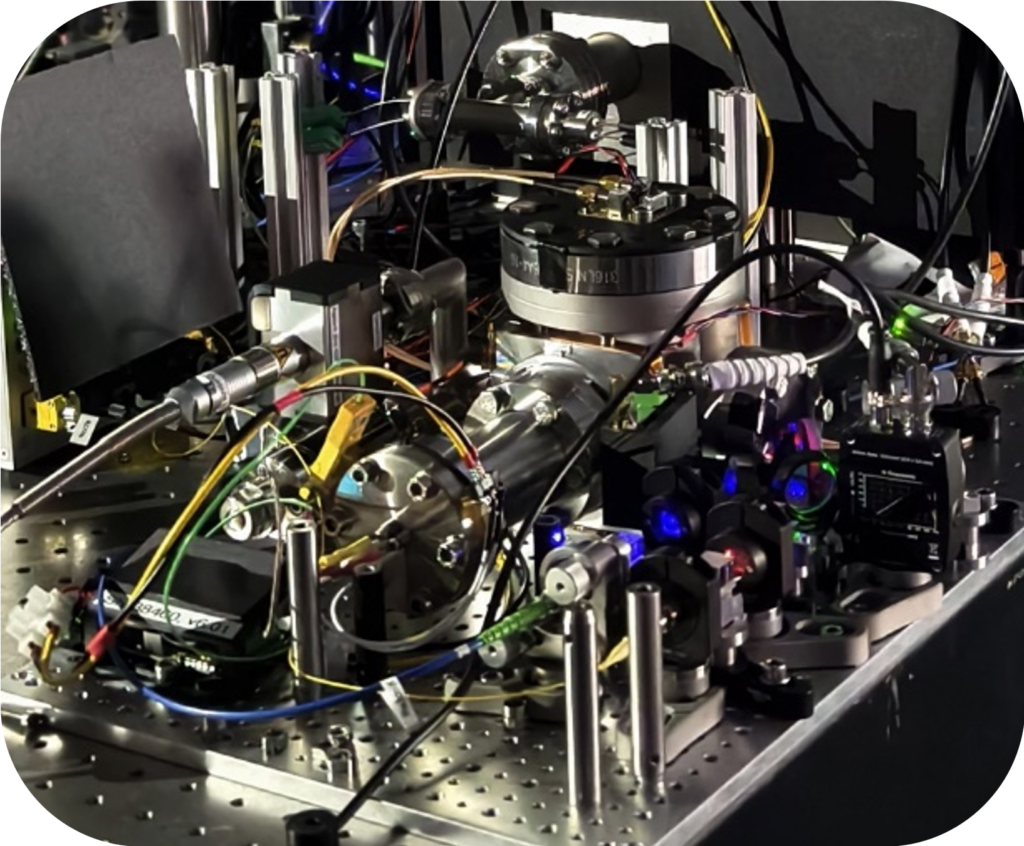
After demonstrating Ramsey-Bordé interferometry with strontium in the laboratory [1,4], we are now working on a portable 4 HU spectroscopy setup and characterising its clock performance.
As a next step towards a space-qualified optical clock, we are preparing an in-orbit demonstration of core clock components, with a launch planned for mid-2028.
Lattice Clocks
Strontium optical lattice clocks currently achieve among the lowest frequency instabilities and systematic uncertainties demonstrated in atomic clocks.
Beyond timekeeping, this precision can be exploited for fundamental science, including searches for dark matter, gravitational-wave detection, and measurements of the gravitational potential [2].
Many of these applications require portable or even space-qualified clocks, which remains a major challenge for such complex systems.
We are currently developing both a laboratory-based strontium lattice clock as a ground testbed and miniaturised, mature subsystems for mobile and space applications.
Superradiance
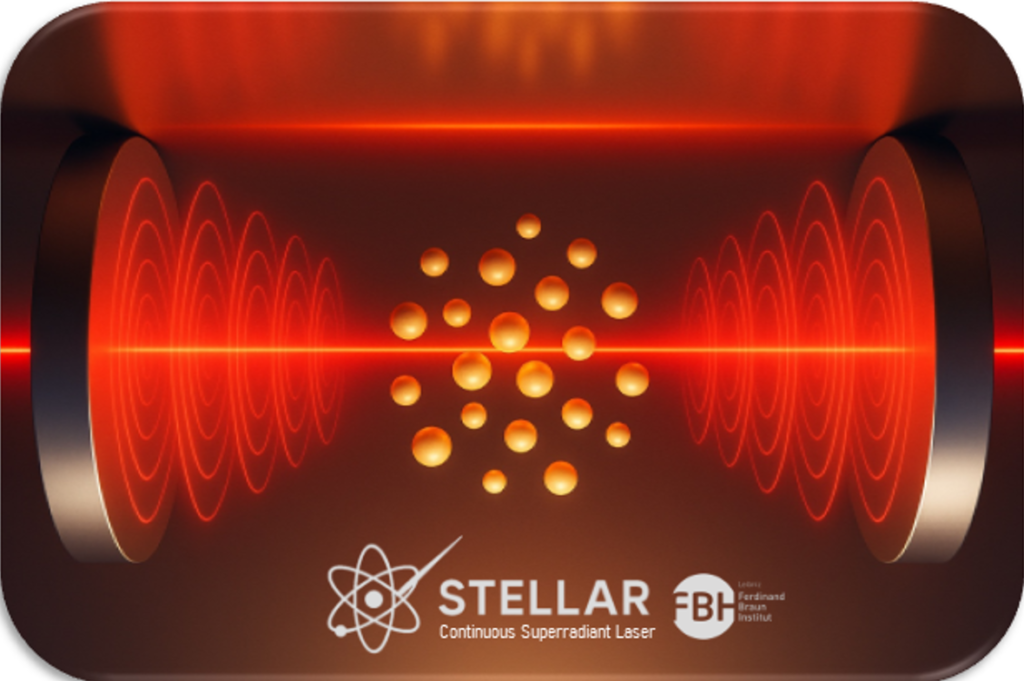
The STELLAR project explores a new way of generating ultra-stable laser light using the collective emission of atoms, a phenomenon known as superradiance. Today’s optical atomic clocks are typically operated as passive clocks: a laser is first stabilised to an optical cavity and then repeatedly compared to an atomic transition, which serves as the ultimate frequency reference.
In an active optical clock based on superradiance, this concept is taken one step further: the atoms themselves collectively emit light at the clock frequency, making the optical signal directly emerge from the atomic reference.
STELLAR aims to realise this principle in continuous operation by coupling a thermal beam of strontium atoms to a so-called „bad“ optical cavity. This approach could strongly reduce the influence of cavity-length fluctuations and enable compact, robust optical clocks with exceptional stability, opening new possibilities for precision measurements, future space missions, and tests of fundamental physics.
Contact
- General inquiry: Prof. Dr. Markus Krutzik and Dr. Amir Mahdian
- Ramsey-Bordé clocks: Dr. Oliver Fartmann and Dr. Amir Mahdian
- Lattice clocks: Christoph Pyrlik and Dr. Henri Zimmermann
- Superradiance: Dr. Amir Mahdian
Publications
[1] O. Fartmann, M. Jutisz, A. Mahdian, V. Schkolnik, I. Tietje, C. Zimmermann and M. Krutzik. „Ramsey-Bordé Atom Interferometry with a Thermal Strontium Beam for a Compact Optical Clock“; EPJ QT 12, 31 (2025)
[2] V. Schkolnik, D. Budker, O. Fartmann, V. Flambaum, L. Hollberg, T. Kalaydzhyan, S. Kolkowitz, M. Krutzik, A. Ludlow, N. Newbury, C. Pyrlik, L. Sinclair, Y. Stadnik, I. Tietje, J. Ye and J. Williams. „Optical Atomic Clock aboard an Earth-Orbiting Space Station (OACESS): Enhancing Searches for Physics beyond the Standard Model in Space“; Quantum Sci. Technol. 8 014003 (2023).
[3] V. Schkolnik, O. Fartmann and M. Krutzik. „An Extended-Cavity Diode Laser at 497 nm for Laser Cooling and Trapping of Neutral Strontium“. Laser Physics 29, 035802 (2019).
Theses
[4] Oliver Fartmann, „Ramsey-Bordé Interferometry on a Thermal Strontium Beam for a Compact Optical Clock“; PhD Thesis, Humboldt-Universität zu Berlin (2026)
[5] Christophe Mullesch, „Theoretical Investigation of a Continuous Superradiant Laser Based on a Thermal Beam of 88Sr“; M.Sc. Thesis (2026)
[6] Levi Wihan, „Numerical Simulations and Differential Wavefront Analysis for Ramsey-Bordé Interferometry“; B.Sc. Thesis, Humboldt-Universität zu Berlin (2024)
[7] Martin Jutisz, „Development of a Compact and Efficient Ramsey-Bordé Spectroscopy Unit“, M.Sc. Thesis, Humboldt-Universität zu Berlin (2021)
[8] Conrad Zimmermann, „A Cavity-Stabilized Laser System for Ramsey-Bordé Spectroscopy of Thermal Strontium“, M.Sc. Thesis, Humboldt-Universität zu Berlin (2021)
[9] Oliver Fartmann, „Towards the realisation of an optical frequency standard based on an atomic strontium beam“, M.Sc. Thesis, Humboldt-Universität zu Berlin (2019)
[10] Oliver Fartmann, „Aufbau und Charakterisierung einer Spektroskopieeinheit für atomares Strontium“, B.Sc. Thesis, Humboldt-Universität zu Berlin (2017)
Funded and/or supported by:
